
Around 2018, many organizations ran their first serious evaluation of metal AM simulation. A shortlist of tools, a couple of benchmarks, some internal debate between design, process and FEA teams, and then a decision: buy one of them, build something in-house, or decide that “simulation doesn’t really help us”.
From that point on, the story in a lot of companies has been simple: “We already looked at simulation.” The box is mentally ticked.
But the world you are printing in today is not the world you evaluated in 2018. And treating those decisions as final is quietly holding metal AM back.
THE PARTS HAVE CHANGED
Most 2018 bake-offs were run on modest geometries: coupons, small brackets, simple manifolds. Even on these comparatively simple geometries of the past, model accuracy and speed were frequently not acceptable, causing many companies to use experimental trial and error as the de facto approach producing parts.
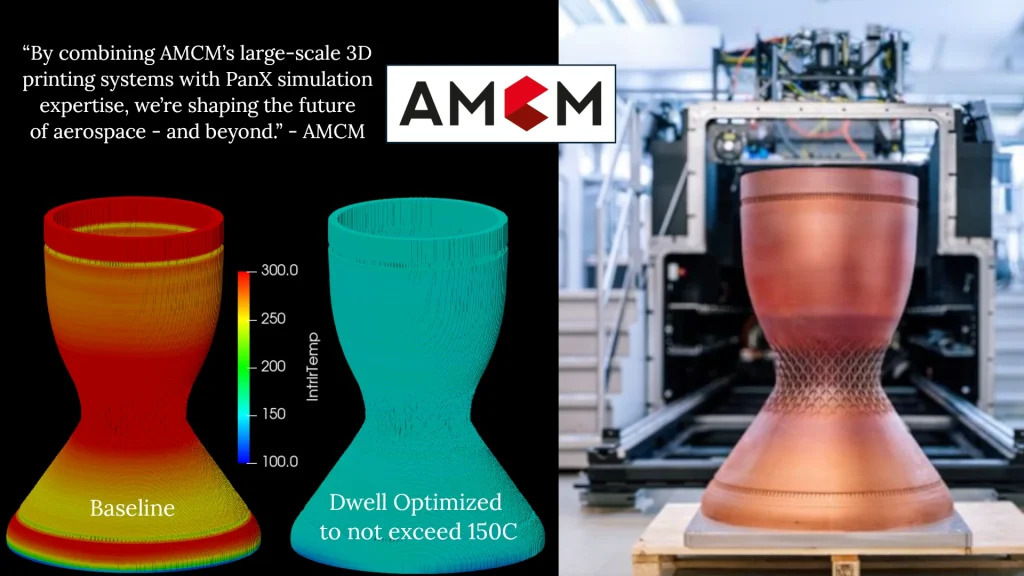
Today’s critical parts look very different. Part size and complexity have now dramatically increased. Rocket hardware, dense heat exchangers, large structural components, and part-scale DED repairs all push old simulation tools well past their computational limits, making simulation of such components impossible. Mesh counts explode. Run times balloon. The solver just fails, and teams fall back (explicitly or quietly) to trial-and-error.
These parts are extremely expensive, with prints frequently hitting costs in the 6-figures an accurate and scalable simulation tool is needed to:
- Make metal AM profitable
- Increase machine throughput and uptime
- Reduce costs associated with failed prints and rework
- Shorten time to production and qualification
PanX is an enabling technology designed specifically to solve the problems of modern AM. In practice, it is the only production-ready solver that can handle these complex parts at the required model resolution and accuracy. Parts that can be simulated with old solvers will run 10-100x faster and with superior accuracy. This is why PanX is used by organizations like AMCM.
THE QUESTIONS HAVE CHANGED
In 2018, the dominant question was: “Can you predict distortion?” Distortion still matters, but it isn’t the whole story, and it isn’t the same story for everyone.
Engineers are trying to move beyond rough distortion trend prediction and use simulation for:
- Part design (orientation & features)
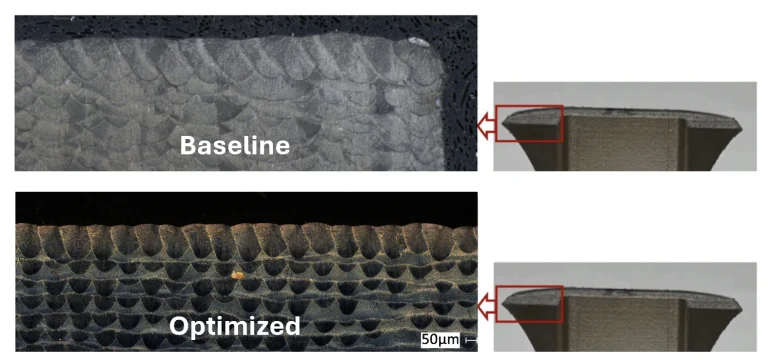
- Part qualification (thermal history, defect risk, mechanical properties)
- High-accuracy temperature and distortion/stress prediction
- Process optimization (dwell-times, process parameters, geometries)
A solver that only produces stress and distortion plots is misaligned with the decisions that actually govern flight readiness, warranty exposure, and program economics.
PanX was built explicitly with those qualification-grade and business-critical questions in mind – not as a prettier way to look at the same old contours, but as infrastructure for how metal AM gets designed, qualified and run in production.
THE ECOSYSTEM HAS CHANGED
The tool landscape you evaluated in 2018 has moved on, or, in many cases, not moved at all. Old solvers have shrinking dev teams, frozen roadmaps, or have been absorbed into portfolios where AM is no longer the priority.
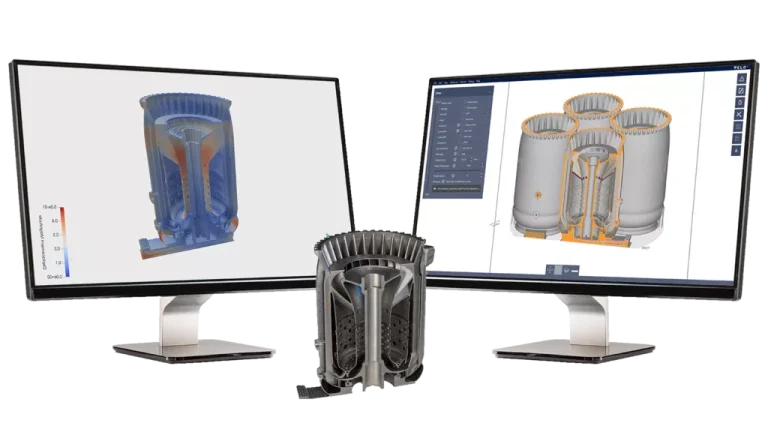
At the same time, OEMs and build-prep vendors now expose richer interfaces. That opens the door to something that simply wasn’t realistic in most 2018 trials, namely simulation as an engine behind your existing workflows, feeding insight into dwell, power, and support strategies rather than living as a separate island.
Such an integration has already been demonstrated and released with Velo3D’s Flow.
This is central to our 2026 vision for PanX. Prediction plus optimization, delivered through OEM and ecosystem integrations so that engineers experience it as part of everyday work, not an extra task.
RE-OPENING THE CONVERSATION
Revisiting your simulation decision is not an admission that 2018 was “wrong”. It’s an acknowledgment that metal AM has grown up.
If your critical parts are bigger, your qualification burden is heavier, your timelines are tighter, and your tools are unchanged, something has to give.
The questions to ask now are simple:
- Can our current tools handle the largest, most complex parts we actually care about?
- Do they support qualification-grade questions, not just distortion?
- Are they fast enough to be used as a design and optimization engine, not just a report generator?
- Is there a credible roadmap for OEM integrations and process optimization, or are we running on frozen code?
If the honest answers are uncomfortable, your 2018 evaluation has expired.
Over the coming months, we’ll unpack what a modern metal AM simulation and optimization stack looks like, and how PanX is being used today as the infrastructure behind first-time-right, production-grade metal AM.