
PanX is known for helping teams accelerate manufacturing and qualification of some of the largest and most complex production components: aerospike engines, combustion chambers, heat-exchangers, etc. For these parts, the value proposition of PanX is clear: saving a single print can easily justify the cost of a license. That focus has shaped much of the public conversation around the platform.
However, PanX is not only valuable on these large parts. For many small and mid-sized manufacturers, the real damage comes from repeated smaller failures: scrapped builds, preventable rework, schedule slips, and uncertainty that makes quoting harder and margins thinner. Here, we look at that practical value through the experience of Mark Kirby of Tronos Aviation, whose perspective shows why simulation matters even on smaller format prints.
PANX AT TRONOS
Tronos Aviation is an aircraft leasing and maintenance service provider with an Advanced Manufacturing facility located on Prince Edward Island. They are among the first 3rd party organizations to receive FAA PMA approval for a high criticality component manufactured using AM.
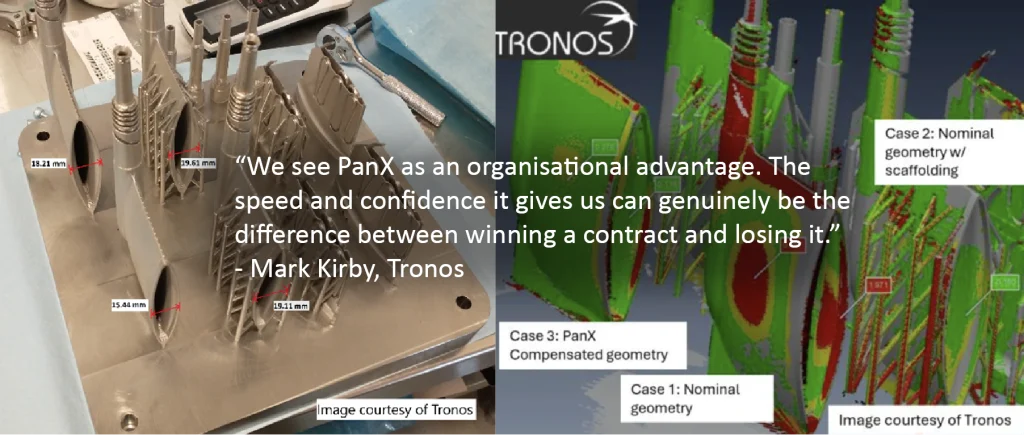
Their interest in AM simulation is driven less by concern around single costly build failure and more about the time to a successful print. They win contracts because they can deliver reliably under tight timelines. PanX supports that critical need by helping them to move faster with fewer surprises. Mark Kirby puts it plainly: “We see PanX as an organisational advantage. The speed and confidence it gives us can genuinely be the difference between winning a contract and losing it.” That framing is important. For businesses like Tronos, simulation is not just a technical safeguard; it is part of how the business competes.
An example use-case print from Tronos can be seen below. This pitot-tube is printed with added scaffolding on the outer-edges, to increase the chance of meeting the required dimensional tolerance on the print. Ideally, the part could be printed within tolerance, without adding the scaffolding, which requires additional material and post-processing effort to build and remove. It is an ideal application for distortion compensation using PanX.
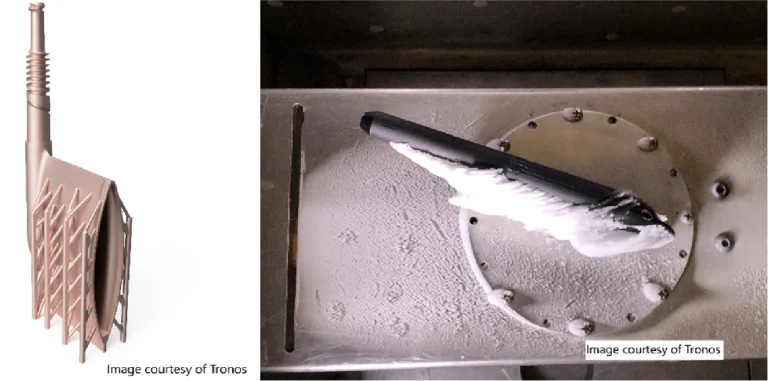
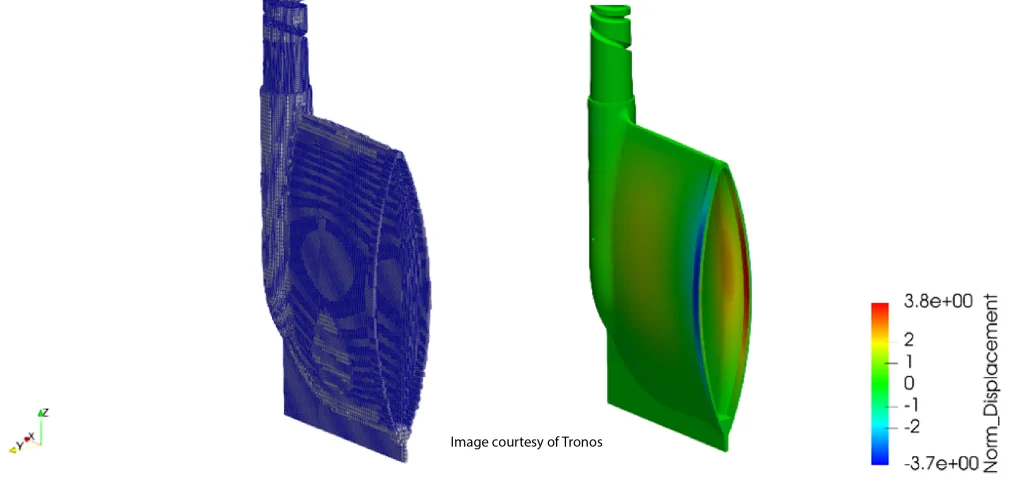
The finite element mesh used for the PanX simulation has 444,000 nodes, which would be a relatively large model by the standards of the old AM simulation tools. However, PanX completes the analysis on a laptop computer in just 7 minutes using 3GB of memory.
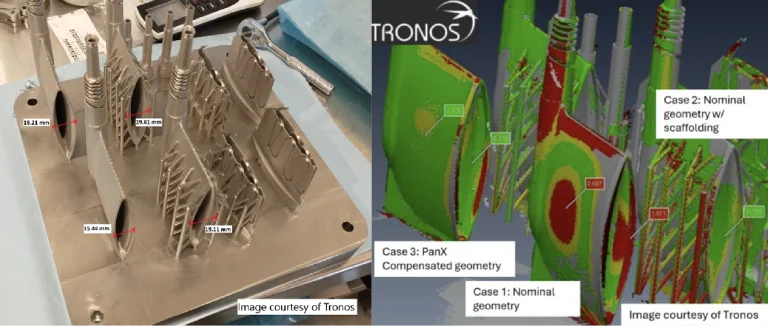
Tronos printed 3 versions of the pitot-tube: Case 1: the nominal geometry, Case 2: the nominal geometry with added scaffolding, and Case 3: the PanX compensated geometry. The image below shows that PanX compensation is able to eliminate most distortion, and will allow subsequent prints to abandon the scaffolding.
The real value of PanX is not simply that it can scale to the largest parts on the market; it is that it can accurately predict and optimize build outcomes on modest hardware quickly enough to influence everyday decisions on real production schedules. In Mark Kirby’s words, PanX is practical enough to become “part of the day-to-day workflow,” rather than something teams use only occasionally.
Part of that practicality is thanks to the fact that PanX integrates directly into existing production workflows and is designed to be used by design and manufacturing engineers, rather than by dedicated analysts with finite element expertise. That accessibility is essential in fast-moving production environments, where insights are most useful when the people closest to the part can act on them directly. Strong customer support reinforces that usability. PanX users are backed by application engineers with deep academic and industrial experience, helping teams adopt the software quickly and apply it effectively to real-world manufacturing challenges. As Mark Kirby notes, PanX “acts as a safety net, helping less-experienced people avoid the mistakes we’ve all made, without dumbing anything down for experienced users.”
Seen in that light, PanX is not just a tool for large-format components. It is a practical production advantage for manufacturers working at any scale. Whether the goal is to qualify a highly complex flagship part or to improve throughput and quoting confidence on everyday jobs, the same principle applies: replacing experimental work with virtual work saves time and money.