
INTRODUCTION: PANOPTIMIZATION’S VIEW OF THE MARKET
There is growing awareness across industry, government, and regulatory bodies that AM will only reach full industrial maturity when it is supported by physics-based models in the same way as other advanced industries. Qualification, certification, and production reliability cannot depend indefinitely on trial-and-error builds.
The move toward industrialization and production creates huge demand for simulation tools that can create a “digital twin” of manufactured parts. For manufacturers, this is critical. If simulation can predict the outcome of a build quickly and accurately, it becomes a way to identify risk before material, machine time, and production schedules are put at risk. This is particularly relevant for aerospace, defence, energy, new-space, and other high-value AM applications, where failed builds and failed part qualification are most costly.
Traditional simulation tools have not delivered on this need as they struggle with both accuracy and scalability. They do not fully capture the underlying thermal and mechanical physics and cannot efficiently model full build-volumes and the thermal and mechanical interactions that occur between parts on the plate. These limitations have contributed to narrow adoption of simulation, particularly for demanding industrial applications where scalability, computation speed, and confidence in the simulation accuracy are critical.
Industry is now converging on PanX as the solution to these problems.
What follows is a summary of AFRL-supported research regarding model validation of PanX for entire build-volumes. It should be noted that the paper erroneously states that PanX uses a “Multi-Scale” modeling approach. This is likely a typo that should have read “Multi-Grid” modeling approach, a novel numeric approach for combining the results of a series of transient solutions. More information on Multi-Grid modeling and the specific octree coarsening scheme used by PanX can be found here: https://www.panoptimization.com/technology/#Multi-Grid-Modeling and here: https://www.panoptimization.com/technology/#Periodic-Adaptivity. This should help the reader understand why some results presented in the paper show very coarse meshes, and others show very fine meshes with all model details intact. It should also be noted that the accuracy of the simulation results presented in the study could be greatly improved by including the actual machine process timing per layer and energy input across each layer. PanX can account for both, but neither was included in this study. The reported thermal prediction error should be considered a floor for what PanX is able to achieve.
OVERVIEW OF THE RESEARCH
Full article available here: https://link.springer.com/article/10.1007/s00170-026-18300-5
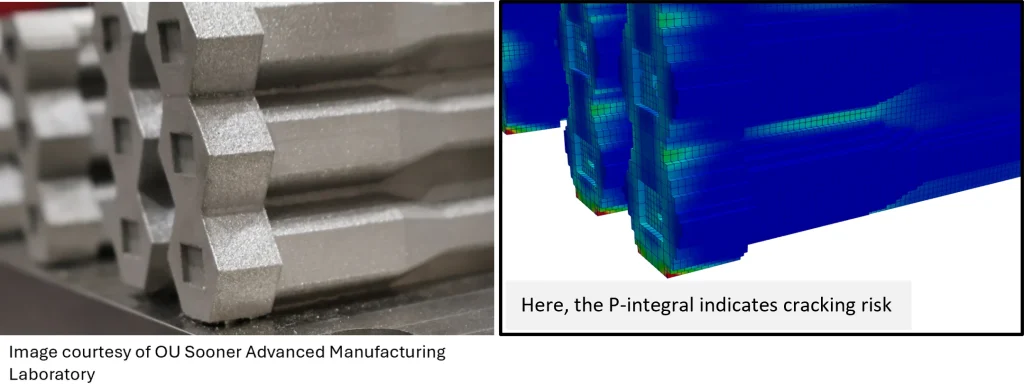
The Air Force Research Laboratory and the Oklahoma Aerospace and Defense Innovation Institute at the University of Oklahoma recently supported work aimed at ensuring manufacturing success and reliability by establishing a Digital Twin framework driven by PanX’s state-of-the-art FEA modeling capabilities. The researchers validated against experiments the thermal and mechanical simulation predictions for entire build volumes consisting of many parts. The inclusion of full build volumes is important because the work did not simply assess a single isolated component. Thermal validation was performed by comparing computed interlayer temperatures to those measured in situ while mechanical validation was performed by comparing high P-integral regions to crack locations observed on the actual prints.
CONCLUSIONS OF THE RESEARCH
The main conclusions of the work are summarized as follows:
- PanX accurately computed interlayer temperature throughout the print, with errors in the range of 2–14% and demonstrated the ability to identify crack-risk locations using a novel “P-integral” approach.
- The PanX simulations represent a paradigm shift for AM modelling by enabling the thermal and mechanical response of the entire build plate to be computed, including loose powder and the interactions between multiple parts. This contrasts with older approaches that often rely on time-intensive simulations of individual components, missing the full build-volume effect which are critical.
- PanX can account for variable geometries and build layouts. This is unique compared to old simulation approaches which typically require calibration on a per-geometry basis, because the process physics are not adequately captured.
- The accuracy and transferability demonstrated in the study support the creation of a Digital Twin framework for AM, enabling earlier risk detection, better design-stage decisions, and more reliable fabrication outcomes.